





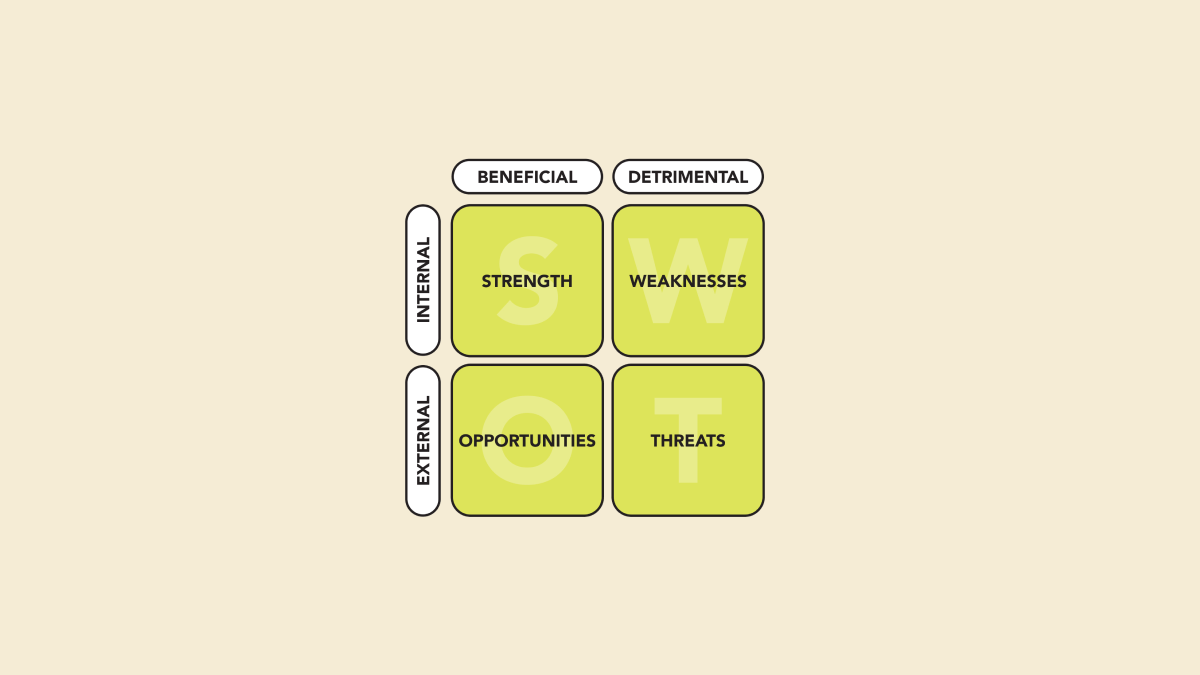
SWOT analysis is a strategic planning method that allows an organization to develop an effective action strategy. It is based on the assessment of four key aspects of the business:
S (Strengths). Unique advantages of the company that distinguish it in the market.
W (Weaknesses). Factors that make the business less resilient.
O (Opportunities). External conditions that can be used for development.
T (Threats). Factors that can negatively affect the company’s activities.
Why is SWOT analysis necessary?
The concept of SWOT analysis was first used by American academic Kenneth Andrews in 1963 at a Harvard Business School conference. Since then, the method has become an indispensable tool for companies of all sizes, from startups to international corporations.
For startups
New companies must carefully analyze their opportunities and threats before entering the market. For example, when launching a new social network, it is important to consider:
– the level of competition in the field,
– potential alternatives for users,
– the influence of consumers on the market,
– your own unique selling proposition (USP).
For large companies
Large corporations are advised to conduct a SWOT analysis at least once a year. This helps them adapt to constant changes in market conditions and develop competitive advantages.
Read also: How to save a YouTube video?
Example of a SWOT analysis for a small business
Strengths
– High quality coffee and desserts
– Loyal regular customers
– Unique atmosphere (cozy interior, pleasant music)
– Polite and professional staff
– Use of fresh, local products
– Flexibility in introducing new products (original drinks, seasonal offers)
- Weaknesses
– High cost of products
– Low brand awareness (especially if the coffee shop is new)
– Limited advertising campaign (little online promotion)
– Small premises (limited seating)
– Dependence on coffee and ingredient suppliers - Opportunities
– Growing popularity of high-quality coffee culture
– Collaboration with local producers and farmers
– Use of social media for promotion (Instagram, TikTok)
– Introduction of coffee and dessert delivery
– Hosting events (master classes, live music nights)
– Launch of a loyalty program (bonuses, discounts for regular customers) - Threats
– High competition (chain coffee shops and large franchises)
– Rising prices for coffee and other ingredients
– Changes in consumer preferences (popularization of alternative beverages)
– Economic instability affecting purchasing power
– Strict sanitary standards and possible restrictions due to pandemics
What to do based on SWOT analysis?
- Strengthen marketing: use social media more actively, launch targeted advertising.
- Optimize costs: find reliable suppliers with favorable terms.
- Expand the range: add new drinks, desserts, vegan and gluten-free options.
- Develop customer loyalty: introduce loyalty cards and discounts for regular customers.
- Strengthen competitive advantages: create unique signature drinks, organize events, add a takeaway menu.
SWOT analysis helps you understand what to focus on, what to improve, and how to move forward to grow your business
Advantages and disadvantages of SWOT analysis
Advantages of SWOT analysis
Easy to use
- Does not require special knowledge or complex tools.
- Can be conducted independently or with a team without involving expensive experts.
- Helps to understand the real situation of the business
- Provides a clear picture of internal (strengths and weaknesses) and external (opportunities and threats) factors.
Flexibility
- Can be used for any business, project, or even personal development.
- Helps make strategic decisions at different levels of management.
Facilitates decision-making
- Allows you to assess risks and potential benefits before implementing changes.
- Enables effective resource allocation.
Provides strategic vision
- Helps build competitive advantages and find ways to grow.
- Allows you to identify key threats and prepare for them in a timely manner.
Disadvantages of SWOT analysis
Subjectivity of assessment
- The results depend on the perception of the person conducting the analysis.
- The lack of clear criteria can lead to biased conclusions.
Limited detail
- SWOT analysis provides only a general overview of the state of affairs.
- Does not take into account specific data, financial indicators, or in-depth market analysis.
- Does not take into account the relationships between factors
- For example, one weakness can affect several threats or opportunities, which is not always reflected in the SWOT matrix.
May become outdated
- If the analysis is not updated regularly, the information may become irrelevant.
- The market situation changes quickly, so a one-time SWOT analysis is insufficient for long-term planning.
Does not offer specific solutions
- SWOT only identifies problems but does not provide clear answers on how to solve them.
Additional action plans and deeper analysis are needed.
- SWOT analysis is an effective strategic tool that helps assess the state of a business or project. However, to gain a complete understanding of the situation, it should be combined with other analysis methods, such as PEST analysis, competitive analysis, financial audit, etc.
Use SWOT for strategic vision and to identify key areas for development.
Do not rely on it as the only analytical tool, as it has its limitations.
Read also: Itten color wheel


Leave a comment